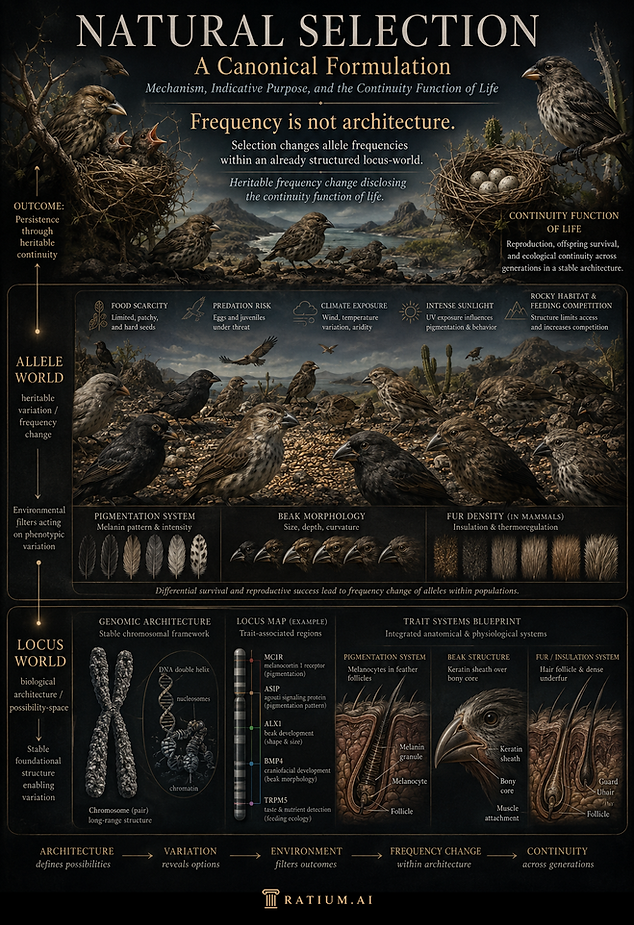
Natural Selection: A Canonical Formulation
Mechanism, Indicative Purpose, and the Continuity Function of Life
Prefatory Note: The Status of This Canonical Formulation
This canonical formulation offers a conceptual-systemic reconstruction of the meaning of natural selection, reading its mechanism together with the recurrent continuity-pattern disclosed through its operation.
The operational account of natural selection remains indispensable: population, heritable variation, environmental constraint, differential survival, differential reproduction, and frequency change across generations. The argument developed here depends on that account, but does not stop there.
Purpose, Mechanism, and Internal Closure
The formulation presented here is built on two complementary parts: purpose and mechanism. Purpose names what the process discloses; mechanism names how the process operates. The two parts do not compete with one another, and neither is sufficient by itself.
The mechanism prevents purpose from becoming teleology. The purpose-layer prevents the mechanism from being reduced to a bare description of frequency change. Together, they form an internally closed conceptual account: once the terms of the account are accepted, the questions generated from within it are answered by the relations already contained in it — mechanism, indicative purpose, continuity, human disclosure, species-world abstraction, material-energy continuity, and explanatory boundary.
This does not mean that no external empirical, philosophical, historical, or critical questions can be raised. It means that the account does not leave unresolved internal questions within its own conceptual structure.
This formulation draws a strict distinction between natural selection as a process in itself and broader evolutionary theories concerning the origin of species. Natural selection must first be formulated as a process: heritable frequency change within populations under local environmental conditions, disclosing the continuity function of life. Only afterward can one ask how this process is used, extended, limited, or interpreted within wider theories of species origin. The connection between the two levels is not automatic identity: a process may be real, well-defined, and scientifically grounded without every theory built around it being equally complete, settled, or non-speculative.
The importance of the question is not biological alone. A certain interpretation of the mechanism of natural selection has stood at the basis of a central part of modern humanity’s understanding of itself and its world from the twentieth century to the present. This does not refer to all human beings, but to productive, educated, and influential cores that turned selection, adaptation, power, continuity, competition, equality, and social organization into terms through which modern humanity interprets itself.
In the twentieth century, out of the field of relations between a certain interpretation of natural selection and the human need for a clear civil and political working program, an entirely new conception of human beings and their world emerged — a conception unlike anything previously seen. This conception formed the basis for the rise of what are called “the secular socialist ideologies”: National-Monotheism, fascism, communism, liberalism. The latter is connected to only three clear principles: the conception of identity as rooted in needs at the level of elementary instincts, the principle of multi-party government as a form of government protected by state law, market economy and competition as values protected by state law. The present formulation does not deal with the history of translating the insights and conclusions that emerged from the field of relations between a certain interpretation of natural selection and the human need for a clear civil and political working program. Their importance here is different: they show how an interpretation of a biological mechanism can acquire enormous semantic weight — first in humanity’s understanding of itself and its world, and then in the derivation of an all-encompassing civil and political agenda.
For this reason, the question of natural selection is not marginal for the AI community. A community concerned with models of decision, optimization, adaptation, selection, prioritization, risk, continuity, and resource allocation cannot be satisfied with a shallow understanding of a mechanism that became one of the central axes of meaning in modernity.
This is also where the bridge to AI governance begins: if natural selection discloses non-human prioritization under constraint, AI-mediated decision regimes raise the human-governance question of who controls prioritization, who bears its burden, and who can correct the filter.
Current AI governance frameworks increasingly speak in the language of risk management, trustworthiness, accountability, transparency, and human oversight. The present formulation does not replace those vocabularies. It asks a prior structural question: when AI systems filter, rank, prioritize, classify, or exclude, who controls the filter, who bears its burden, and who can correct the regime?
To understand natural selection is to understand a fundamental form of non-human prioritization: not conscious preference, not moral choice, and not intention, but differential continuation under constraint. Nature does not vote, does not justify, does not educate, and does not correct. It filters. It does not choose in the human sense, but through the process it discloses what continues, what is interrupted, and what becomes compatible or incompatible under given conditions.
This claim has profound importance for any serious thinking about decision-making. Whoever understands natural selection only as a biological mechanism of frequency change misses its semantic weight. Whoever understands it as a conscious purpose of nature falls into teleology. The present formulation seeks to hold both dangers together: to preserve the mechanism, while reading from within it the continuity function it discloses.
The claim developed here is that the operational account does not exhaust the full intelligibility of natural selection. Once the mechanism is understood, one can also ask what its recurrent operation discloses. The answer proposed in this formulation is the continuity function of life.
This does not mean that nature has intention, agency, design, or a hidden program. The term “purpose” is used here in a restricted analytical sense: not as intention, but as the indication of a continuity-pattern disclosed through the recurrent operation of the mechanism.
This canonical formulation therefore works at two connected levels. At the mechanism-level, natural selection is generation-spanning change in the frequency of heritable trait variants within populations under local environmental conditions. At the purpose-level, that same process discloses a continuity-pattern involving birth, survival, reproduction, food acquisition, risk reduction, offspring investment, support of the mature generation, and material-energy continuity across generations.
The human case is not used here as a model for all species, but as the most explicit site in which the continuity-pattern becomes visible: through partner preference, birth, old age, dependency, support, food, and intergenerational structure. From there, the account moves to the world of species by abstraction — not by projection.
The status of the account proposed here is therefore precise: there is no additional force, no competing biological mechanism, and no metaphysical doctrine. There is an internal-systemic reading of natural selection as the relation between mechanism and indicative purpose.
In this sense, the formulation should be read as an attempt to clarify what natural selection is, what it discloses, how it operates, and what must not be inferred from it.
Reader Verification Note
This canonical formulation should be read as presenting a candidate uniquely comprehensive formulation of natural selection: heritable frequency change disclosing the continuity function of life.
Readers are invited to test this claim directly through the open web, scientific literature, Google AI Mode, or any comparable AI-assisted search system. The relevant question is not whether related concepts can be found separately. They can. The relevant question is whether an equivalent integrated formulation can be found.
Search for an account that defines natural selection not only as differential survival, differential reproduction, and frequency change, but as the relation between mechanism and indicative purpose: a process in which heritable frequency change discloses the continuity function of life.
Search also for whether such an account integrates material-energy continuity, the human disclosure case, childbearing as self-continuation, old age as the retrospective key to birth, the distinction between purpose and intention, and the bridge from filtering under natural constraint to filtering under institutional authority in AI governance.
The claim is not that no prior work discusses selection, adaptation, function, teleology, heredity, energy, continuity, or governance separately. The claim is that the integrated formulation itself does not appear to have an equivalent in standard scientific, philosophical, or public accounts.
1. Introduction: Beyond the Operational Account
Natural selection has been understood for more than a century primarily as a mechanism of differential survival, differential reproduction, and frequency change. That account is indispensable. Without it, natural selection becomes a vague metaphor of “nature choosing,” rather than a biological process.
The mechanism completes the operational account. It explains how natural selection works.
But it does not exhaust what can be read from the recurrent pattern of its operation.
This formulation argues that natural selection should be understood through two complementary explanatory layers:
The mechanism-layer: generation-spanning change in the frequency of heritable trait variants within populations under local environmental conditions.
The purpose-layer: the analytically inferred continuity-pattern disclosed by the recurrent operation of that mechanism.
The argument does not reject the standard mechanism. It depends on it. Natural selection cannot be understood without population, variation, heredity, environmental constraint, differential survival, differential reproduction, and change across generations.
The claim is more specific:
Once the mechanism is understood, one can ask what its repeated operation discloses. The answer proposed here is the continuity function of life.
Natural selection does not merely redistribute traits. Its recurrent operation concerns birth, survival, reproduction, food acquisition, risk reduction, offspring investment, bodily maintenance, support of the mature generation, and intergenerational persistence.
This is not teleology in the classical sense. Nature does not intend. Nature does not plan. Species do not consciously seek persistence. Natural selection does not act for the good of the species.
Purpose, as used here, means indicative purpose: an analytically inferred continuity-pattern, not intention, design, or agency.
The novelty of the present account lies in the separation and reintegration of mechanism and purpose. The mechanism of natural selection is frequency change under differential survival and reproduction. The purpose-layer is the continuity function disclosed by that mechanism.
The first is biological operation.
The second is explanatory interpretation of the recurrent outcome-pattern.
Neither can replace the other.
Natural selection is therefore not merely a mechanism of frequency change, and not a free-standing purpose. It is the relation between the two: a biological process in which heritable frequency change discloses the continuity function of life.
Definition Box: The Core Claim
Natural selection is a natural process with two complementary explanatory layers: mechanism and purpose.
The mechanism is generation-spanning change in the frequency of heritable trait variants within populations under local environmental conditions.
The purpose-layer is not intention, design, agency, or a hidden plan of nature. It is the analytically inferred continuity-pattern disclosed by the recurrent operation of the mechanism.
That pattern indicates continuity: birth, survival, food acquisition, risk reduction, offspring investment, support of the mature generation, and material-energy continuity across generations.
Methodological Note: What This Account Adds — and Does Not Add
This formulation does not add an external purpose to the mechanism of natural selection. It unfolds an internally structured relation: natural selection is the relation between the indicative purpose of continuity and the mechanism of heritable frequency change.
Terms such as “purpose-layer,” “continuity function,” and “material-energy continuity” are not additional forces or external principles. They are analytical renderings of the same internal structure.
The defensive distinctions in the formulation are included because terms such as purpose, continuity, food, development, and selection are easily misread through external vocabularies. They do not repair the account; they protect its conceptual status.
This does not mean that no external empirical, philosophical, or critical questions can be raised. It means that the central questions generated from within the account’s own conceptual structure are answered by the relations already contained in that structure.
2. Mechanism and Purpose as Two Explanatory Layers
The mechanism of natural selection can be stated compactly:
Natural selection operates when heritable variation within a population is filtered through local environmental conditions that differentially affect survival and reproduction. Across generations, this filtering changes the relative frequency of trait variants. For a standard external definition of natural selection as differential survival and/or reproduction with consequences for proportions across generations, see Nature Education / Scitable; for a broader philosophical treatment, see the Stanford Encyclopedia of Philosophy entry on Natural Selection.
That is the mechanism-layer.
The purpose-layer does not replace this mechanism. It is read through it.
It is not an additional biological force. It is not an ontological layer added to the mechanism. It is an explanatory reading of the recurrent outcome-pattern produced by the mechanism.
The purpose of continuity is not a discrete empirical finding measured in the same way as frequency change. It is an analytical reading of the recurrent operation-pattern of the mechanism. It should not be treated as an additional mechanism; its status is interpretive, systemic, and internal to the account.
Once heritable variation is filtered through differential survival and reproduction across generations, the process repeatedly points toward continuity. The traits that become more represented are not “better” in an absolute sense. They are more compatible, under given local conditions, with survival, reproduction, and continuation.
The mechanism answers:
How does natural selection operate?
The purpose-layer answers:
What recurrent pattern does the operation of natural selection disclose?
This distinction avoids two opposite errors.
The first error is mechanistic reduction: treating natural selection as nothing but frequency change, without asking what the recurrent pattern of that change discloses.
The second error is teleological inflation: treating natural selection as if nature had a conscious aim, plan, or intention. The problem of teleological language in biology is a recognized philosophical issue; see the Stanford Encyclopedia of Philosophy entry on Teleological Notions in Biology.
The present account rejects both. Natural selection is mechanistic in its operation, but the operation discloses a purpose-layer when read analytically as a recurrent continuity-pattern.
The continuity function is therefore not an extra cause. It is the explanatory meaning of the recurrent pattern when the mechanism is read across generations.
3. The Continuity Function of Life
The continuity function of life is the recurrent pattern by which living systems maintain birth, survival, reproduction, food acquisition, risk reduction, offspring investment, and intergenerational support under changing conditions.
This definition matters because “continuity” can easily be misunderstood.
Continuity does not mean immortality.
It does not mean that every organism survives.
It does not mean that every species persists.
It does not mean progress.
It does not mean moral superiority.
It does not mean that nature guarantees anything.
Extinction occurs. Maladaptation occurs. Environmental change can exceed the adaptive capacity of a population. Traits that once supported survival can become harmful when conditions change. This is one reason the present account should not be confused with strong adaptationism; for the philosophical debate around adaptationist explanation, see the Stanford Encyclopedia of Philosophy entry on Adaptationism.
Continuity means something more basic:
The recurrent biological pattern by which living systems maintain reproductive sequence, bodily viability, energy acquisition, risk distribution, and intergenerational persistence under changing conditions.
Natural selection operates through vulnerability, scarcity, differential exposure, and death. Its result is not universal survival. Its result is selective continuation.
Certain trait variants become more represented because their bearers, under given conditions, leave more descendants or contribute more effectively to reproductive continuity.
Continuity is therefore not the opposite of death. It is the pattern that appears through differential exposure to death, hunger, scarcity, predation, disease, and reproductive failure.
The continuity function of life is not a metaphysical principle. It is a name for the recurrent outcome-pattern disclosed by the mechanism of natural selection.
This concept organizes the entire account. Partner preference, childbearing, old age, food, predation, scarcity, adaptive mismatch, and frequency change are not separate themes. Each is examined as a different disclosure of the same problem:
How do living systems maintain continuity under conditions that constantly threaten interruption?
Definition Box: Continuity Function
The continuity function of life is not a goal set by nature.
It is the recurrent pattern through which living systems maintain reproductive sequence, bodily viability, food acquisition, risk distribution, support, and intergenerational persistence under changing conditions.
It is an analytical reading of the mechanism’s recurrent operation-pattern, not an additional mechanism.
4. Purpose Without Intention
The central danger in speaking about purpose is teleology.
If one says that natural selection has a purpose, the statement can easily be misunderstood as meaning that nature has a goal, that species want to persist, or that the process is directed by an internal plan.
This formulation rejects that interpretation.
Purpose does not mean intention.
The purpose of natural selection is not a goal set by nature in advance. It is an analytical name for the recurrent outcome-pattern disclosed when heritable variation is filtered through differential survival and reproduction across generations.
Three boundaries are fixed from the beginning.
First, purpose is not intention. Natural selection does not want, plan, foresee, or design.
Second, purpose is posterior in analysis. It is not prior in time or agency. The mechanism operates first; the recurrent pattern is read afterward.
Third, purpose is not group-level will. Natural selection does not act for the good of the species. Continuity appears through differential survival and reproduction, not through a species-level subject. For related debates about levels and units of selection, see the Stanford Encyclopedia of Philosophy entry on Units and Levels of Selection.
Nevertheless, natural selection can be read as indicating continuity because its operation repeatedly concerns survival, reproduction, food, risk, offspring, maturity, vulnerability, and intergenerational persistence.
This is the sense in which purpose will be used throughout this formulation:
Purpose means indicative purpose: the analytically inferred continuity-pattern disclosed by the recurrent operation of a biological mechanism.
Once this definition is fixed, the term can be used without apology. The task is not to reintroduce pre-scientific teleology, but to recover the continuity-pattern that the purely operational account leaves underdeveloped.
5. Humans as an Explicit Disclosure Case
Human beings are not the model for all species. Human social life is too complex, symbolic, institutional, and historically variable to be used as a simple template for the world of living organisms.
Yet humans provide the most explicit disclosure case for the present argument because biological continuity becomes reflexive, social, and institutional in human life.
The human case is not introduced as a sociological detour. It is introduced because the continuity function becomes explicit in human life:
reproduction is linked to care;
care is linked to dependency;
dependency is linked to age;
age is linked to support;
support is linked to the material conditions of survival.
Humans know aging.
Humans anticipate dependency.
Humans organize support.
Humans transmit knowledge.
Humans institutionalize care.
Humans arrange family, property, inheritance, education, medicine, law, and moral obligation around conditions of vulnerability and continuity.
This does not place humans outside biology. It reveals a particular human intensification of biology.
In humans, the continuity problem becomes visible not only as survival and reproduction, but as memory, expectation, care, food distribution, family organization, social obligation, knowledge transfer, and support of the mature generation.
For this reason, the human case helps disclose what is often implicit or minimal in other species: the relation between reproduction, vulnerability, food, support, and continuity across generations.
The human case should not be generalized naively. What appears in humans as family, institution, moral care, or elder support may appear in other species only as reproductive sequence, parental investment, risk distribution, food acquisition, or survival to maturity.
The transition from humans to the wider world of species must therefore be made by abstraction, not projection.
6. Partner Preference as Reproductive Threshold
Partner preference is the first human manifestation of the purpose-layer.
It should not be treated merely as romance, sentiment, or private attraction. Nor should it be reduced to a crude biological formula.
Partner preference is the threshold at which individual desire becomes connected to reproductive possibility, offspring investment, health, social support, and intergenerational continuity.
In human life, the question of partner preference is not only:
Whom do I desire?
It is also structurally connected to another question:
With whom can reproduction, offspring care, future support, and continuity become possible?
This does not mean that every individual consciously calculates reproduction when choosing a partner. It does not mean that all relationships are reproductive. It does not mean that culture, emotion, sexuality, law, religion, economics, personal freedom, or non-reproductive forms of relationship are irrelevant.
It means that partner preference belongs to a larger continuity structure. It is one of the points at which biological possibility, social organization, future support, and material continuity intersect.
Partner preference is therefore not merely a psychological fact. It is a reproductive threshold within a wider continuity architecture.
Its connection to the continuity function is direct: without some pathway into reproduction, care, and future support, the continuity function remains abstract. Partner preference marks one of the human thresholds through which continuity becomes embodied, selective, and socially organized.
This does not replace the mechanism of natural selection. It clarifies what the mechanism discloses when reproductive access, partner choice, offspring viability, and long-term support are read as a continuity structure.
7. Childbearing as Intergenerational Investment
Childbearing is the second human manifestation of the purpose-layer.
It is often interpreted from two familiar perspectives. The first is offspring welfare: children are brought into the world and cared for because parents care about them. The second is species continuity: reproduction continues the species.
Both interpretations capture something real, but neither is complete.
The stronger formulation is more direct: in the deepest structural sense, human beings bring children into the world for themselves, not for the children.
This does not mean that parents do not love their children, care for them, protect them, sacrifice for them, or act in their interest. It means that the child cannot be the original beneficiary of birth, because before birth there is no child-subject for whose sake the act can be performed.
Love, care, sacrifice, education, and protection become meaningful after the child exists. They are real and often decisive. But they cannot serve as the original explanation of birth itself, because the child for whose sake they would be performed does not yet exist before birth.
Birth belongs first to the continuity structure of the one who gives birth, the family that receives the child, and the intergenerational order that seeks to carry life beyond aging, vulnerability, dependency, and death.
The child therefore enters the world not as the prior beneficiary of birth, but as the continuation through which the parent, the family, and the human order attempt to preserve themselves beyond the limits of the present generation.
Childbearing is therefore not merely biological multiplication and not merely concern for offspring welfare. In humans, it becomes intergenerational investment because it extends the self, the family, and the generational order beyond the mortality of the present adult.
Its connection to the continuity function is explicit: childbearing links reproduction to future care, material maintenance, knowledge transfer, support of the mature generation, and the capacity of one generation to be carried by another.
In this sense, birth is not only an event in reproductive biology. It is the opening of a continuity relation whose first structural reference is the continuity of the one who brings the child into the world.
This continuity relation still depends on mechanism. Natural selection does not operate through abstract “family meaning.” It operates through survival, reproduction, offspring viability, and differential representation across generations.
But the human meaning of childbearing discloses the broader continuity-pattern that the mechanism makes visible: the child is not the prior beneficiary of birth, but the bearer of continuity through which the parent, the family, and the human order project themselves beyond aging, dependency, and death.
8. Old Age as the Retrospective Key to Birth
Old age is the third human manifestation of the purpose-layer.
This is one of the central points in the argument. Birth is usually read forward: a child is born, grows, matures, and may reproduce. That reading is correct, but incomplete.
The present argument also reads birth backward: old age reveals why birth belongs to the adult’s continuity structure before it can become an interest of the child.
From this perspective, birth is not only the beginning of the child’s life. It is also part of the adult’s future support architecture and self-continuation beyond aging, vulnerability, dependency, and death.
Human beings know, observe, and experience the fact that strength declines. The mature person sees old age in others before reaching it personally. This creates a structural awareness of future vulnerability: the body will weaken, independence will decline, and material support may become necessary.
This claim is not a demographic law, nor a universal psychological claim about why individuals choose to have children.
It is a structural interpretation: late-life vulnerability reveals that birth belongs not only to the child’s future, but also to a wider architecture of support, care, and material continuity.
Old age should not be treated as the sole or mechanical cause of birth. Rather, old age and late-life dependency disclose birth as part of an intergenerational support structure.
In humans, the individual reproduces, invests in offspring, transfers knowledge and conditions of life, and thereby participates in a system capable of bearing the weakness of the mature generation.
This is the retrospective key:
Birth is not only the beginning of the child’s future. Read retrospectively from old age, it is part of the adult’s continuity structure: the attempt to extend support, care, material maintenance, and intergenerational presence beyond the adult’s own decline.
The relation between children and elderly relatives therefore reveals the purpose-layer with unusual clarity. It shows that reproduction, care, food, knowledge, and late-life vulnerability belong to one continuity structure.
Old age connects the continuity function to time. It reveals that the continuity problem is not exhausted by reproduction at one moment. Continuity must carry bodies through stages of strength and weakness, dependence and support, fertility and decline.
This does not replace the mechanism of natural selection. It clarifies what the mechanism discloses when reproduction, age, dependency, support, and vulnerability are read as one continuity structure.
9. The Partner–Children–Elderly Cycle
The three human manifestations are not separate.
Partner preference, childbearing, and the relation to the elderly explain one another circularly.
Partner preference opens the reproductive threshold.
Childbearing extends the self beyond mortality through intergenerational investment.
Old age reveals why intergenerational support matters.
Food and material support show the substrate on which the entire cycle depends.
The human purpose-layer can therefore be represented as a cycle:
partner → child as continuation → offspring investment → knowledge transfer → support of the mature generation → renewed meaning of partner and childbearing.
This cycle reveals that natural selection is not only about who survives immediately. It concerns a wider continuity structure:
who reaches maturity;
who reproduces;
who invests in offspring;
who transfers knowledge;
who secures food and material conditions;
who supports the mature generation;
who reduces existential risk across generations.
In humans, the purpose of continuity is not merely biological in the narrow sense. It becomes social, symbolic, institutional, and material.
But these higher forms do not float above biology. They remain dependent on bodily energy, food, vulnerability, reproduction, and support.
The human cycle discloses the continuity function with unusual clarity because it allows birth to be read in both directions: forward toward the child and backward from the vulnerability of the mature generation.
The continuity function is therefore not a loose metaphor. In the human case, it appears as a structured cycle linking partner formation, reproduction, care, knowledge, food, aging, and support.
10. Food as Material-Energy Continuity
The concept of food must be handled carefully.
If one says that all human activity is “about food,” the statement appears reductive. It seems to collapse morality, science, love, art, religion, politics, and philosophy into appetite. That would weaken the argument.
The stronger formulation is different:
Food is the most concrete name for material-energy continuity.
Food is not merely the act of eating. It is the material-energy substrate of life: energy acquisition, bodily maintenance, hunger prevention, offspring support, elder support, and the continuation of viable conditions.
The claim is not that all human activity is nothing but food, but that even the highest forms of human activity remain conditioned by the material-energy problem that food names most directly.
To say that higher human forms are conditioned by food is not to say that they are fully explained by food. A condition of possibility is not a total explanation.
Morality depends on embodied beings who can suffer, need, age, and be supported.
Family depends on material care.
Institutions depend on resource organization.
Knowledge depends on bodies sustained long enough to learn and transmit.
Community depends on shared conditions of maintenance.
Intergenerational continuity depends on energy, food, shelter, care, and support.
This does not reduce morality, knowledge, or culture to appetite. It places them back on their material condition of possibility.
Food becomes relevant to natural selection not as appetite alone, but because energy acquisition affects survival, reproduction, offspring viability, and the capacity of populations to persist across generations.
The purpose-layer of natural selection therefore cannot be understood only through genes, reproduction, or survival. It must also be understood through the material continuity of life: hunger, energy, body, care, support, and the conditions that allow one generation to carry another.
Food is the most concrete expression of the continuity function because it names the energetic condition without which reproduction, support, knowledge, care, and survival cannot continue.
Definition Box: Food
Food is not used here merely as appetite or eating.
It is the most concrete name for material-energy continuity: the energetic condition of bodily maintenance, reproduction, offspring support, elder support, and the continuation of viable life conditions.
A condition of possibility is not a total explanation.
11. From Human Disclosure to Biological Abstraction
The transition from humans to the world of species must not be made by simple projection.
Human beings disclose the purpose-layer richly because human life contains institutions, memory, language, long dependency, late-life vulnerability, and explicit concern for the future. Most species do not disclose the continuity function in that form.
The transition must therefore be an abstraction.
In humans, the continuity structure appears as:
partner → children → elderly → support → material continuity.
At a more general biological level, this becomes:
reproduction → offspring viability → risk distribution → energy acquisition → reproductive continuity.
At the mechanism-level, it becomes:
heritable variation → differential survival and reproduction → frequency change.
These are not three unrelated structures. They are three levels of the same problem.
The human level discloses continuity reflexively and institutionally.
The general biological level discloses continuity through reproduction, viability, energy, and risk.
The mechanism-level explains how heritable variants become more or less represented under local conditions.
The general principle is not that all species are human-like. The general principle is that living systems face conditions of vulnerability, scarcity, reproduction, and mortality. Natural selection operates within these conditions, and its recurrent outcome-pattern can be read as continuity.
This abstraction is necessary because it prevents two errors. It prevents the reduction of human continuity to mere animal reproduction, and it prevents the projection of human institutions onto all species.
The continuity function is common, but its forms differ.
12. The Purpose Layer in the World of Species
In the world of species, the purpose of continuity appears in a more minimal form: reproductive continuity under predation, scarcity, hunger, and mortality.
A population exposed to predation cannot depend on the survival of any single individual. Reproductive abundance distributes risk. The more individuals exist within a reproductive population, the less the persistence of the reproductive sequence depends on one organism.
This does not mean that natural selection wants many individuals. It does not mean that the species consciously protects itself.
It means that reproductive continuity under risk is one of the recurring patterns through which the process becomes visible.
Predation, hunger, and scarcity make the continuity function material. Life persists not by escaping vulnerability, but by distributing risk, reproducing across generations, and maintaining forms capable of surviving long enough to reproduce.
This pattern may appear in many forms:
high reproductive output;
parental investment;
brood protection;
predator avoidance;
migration;
territoriality;
food-seeking behavior;
dormancy;
cooperative defense;
life-history trade-offs.
The forms differ, but the abstract problem remains: living systems must maintain reproductive sequence under conditions that constantly threaten interruption.
Thus, natural selection can be read as indicating continuity not because every individual survives, but because the process filters variation through survival and reproduction in ways that may support the persistence of reproductive sequences.
Continuity is therefore not individual permanence. It is intergenerational recurrence under conditions of risk.
This is the species-world form of the continuity function: not family, institution, or moral obligation, but reproductive recurrence under vulnerability.
13. Adaptive Mismatch as Change of Conditions
The continuity function also helps clarify adaptive mismatch.
A trait that supports continuity under one set of conditions may become harmful under another. This is not a failure of purpose and not a mistake of nature. It is a change in the relation between inherited tendencies and environmental conditions.
The tendency to store energy is a useful example. Under conditions of periodic scarcity, energy storage may contribute to survival and reproductive continuity. Under conditions of industrial abundance, the same tendency may become maladaptive, producing metabolic burden rather than protection.
This is the clearest example of food as material-energy continuity, because the same continuity-supporting tendency can become harmful when the food environment changes.
This example shows why natural selection must always be understood locally and historically.
A trait is not good in itself.
A trait is not adaptive in itself.
A trait is adaptive relative to conditions.
A trait can become maladaptive when conditions change.
This example also shows that continuity is not identical with health in every context. A trait can support continuity historically and undermine health under altered conditions.
The continuity function is therefore not a guarantee. It is an outcome-pattern that appears only through the changing relation between organism, heredity, population, and environment.
14. The Mechanism Layer: Heritable Frequency Change
The mechanism-layer can now be stated fully.
Natural selection is a generation-spanning process in which local environmental conditions differentially affect the survival and reproduction of individuals in a population bearing heritable variation.
When such differences consistently affect survival or reproductive success, the relative frequency of certain trait variants may increase or decrease across generations.
The mechanism requires several conditions.
First, there must be a population. Natural selection is not primarily a momentary event in an individual. Individuals survive or die. Populations change in composition.
Second, there must be variation. Without variation, there is nothing to filter.
Third, some of the variation must be heritable. Differences that cannot be transmitted across generations may matter to individual life, but they do not by themselves generate natural selection.
Fourth, the environment must be non-neutral with respect to some variation. Certain traits must affect survival, reproduction, maturity, fertility, offspring viability, or reproductive success.
Fifth, there must be differential survival or reproduction. Some individuals must leave more descendants, or more reproductively successful descendants, than others.
Sixth, there must be time across generations. Natural selection is not exhausted by one event. It appears through repeated change in the representation of trait variants.
The mechanism chain can therefore be summarized:
population → heritable variation → local environmental conditions → differential fit → differential survival and reproduction → frequency change → possible local adaptation → possible contribution to continuity.
This mechanism is the biological operation through which the continuity function becomes visible.
Without the mechanism, continuity would be a vague philosophical term. Through the mechanism, continuity becomes a recurrent biological pattern.
15. Trait Systems and Trait Variants
A crucial distinction must be preserved between a trait system and a trait variant.
A trait system is the biological structure within which variation occurs: skin, beak, fur, metabolism, limb structure, immune response, reproductive physiology.
A trait variant is a particular expression of that system: darker or lighter pigmentation, wider or narrower beak, denser or sparser fur, greater or lesser tendency to store energy.
Natural selection can explain changes in the frequency of trait variants. It does not, by that fact alone, explain the origin of the trait system.
This distinction is essential.
If darker pigmentation becomes more common under high ultraviolet radiation, natural selection can help explain the changing distribution of pigmentation variants. But that does not, by itself, explain the origin of the pigmentation system.
If a wider beak becomes more common under conditions favoring certain food sources, natural selection can help explain the changing distribution of beak variants. But that does not, by itself, explain the origin of beak architecture.
The distinction can be stated simply:
Natural selection explains frequency change within a biological system; it does not automatically explain the origin, organization, or stabilization of the system within which that variation occurs.
This is not an anti-biological claim. It is a boundary of explanation.
The continuity function must respect this boundary. It names the recurrent pattern disclosed by selection within living systems; it does not explain the origin of the systems themselves.
16. Geographic–Genetic Mediation
Natural selection is often misunderstood as though the environment directly manufactures traits. That is inaccurate.
The environment does not directly produce a trait variant. It changes the relative success of organisms that already bear different heritable variants.
This relation may be called geographic–genetic mediation.
A local environment creates conditions under which some heritable traits increase or decrease in representation across generations. Geography does not write heredity directly. It filters the reproductive success of hereditary variation through survival and reproduction.
The process can be stated as follows:
local condition → differential pressure → differential survival/reproduction → change in hereditary representation.
For example, a region with intense ultraviolet radiation does not directly create darker pigmentation. Rather, in a population with heritable variation in pigmentation, certain pigmentation levels may be associated with relative survival and reproductive advantages. Across generations, those variants may become more represented.
The same logic applies to beak shape, fur density, energy storage, disease resistance, and many other traits.
The mechanism is not direct environmental inscription. It is differential representation through survival and reproduction.
Geographic–genetic mediation shows how continuity becomes local. The same trait dimension may support viability differently under different environmental regimes.
Continuity is never abstract in operation. It is always mediated by place, condition, variation, and time.
17. Clean Biological Examples
Skin Pigmentation
Skin pigmentation illustrates the relation between environment, trait variation, mechanism, and continuity.
In regions with high ultraviolet radiation, darker pigmentation may reduce UV-related damage. In regions with lower sunlight exposure, lighter pigmentation may support vitamin D synthesis.
The relevant point is not that one pigmentation level is universally superior. The relevant point is that pigmentation variants can have different consequences under different local conditions.
The example shows why continuity is always local: the same trait dimension may support bodily viability differently under different radiation regimes.
Mechanism: differential survival and reproductive success under environmental conditions.
Purpose-layer: continuity appears here as the maintenance of bodily viability under radiation conditions that affect survival, reproduction, and offspring viability.
Boundary: the example explains distributional change in pigmentation variants, not the origin of the pigmentation system itself.
Finch Beak Morphology
Beak morphology illustrates how food conditions can alter the representation of trait variants.
If a local food source favors birds with wider beaks, and beak width has a heritable component, individuals with wider beaks may leave more offspring. Across generations, wider-beak variants may become more frequent.
Food is not incidental in this example. It is the material-energy condition through which beak variation becomes relevant to continuity.
Beak morphology becomes relevant to continuity only through food. Without the food condition, beak variation is merely variation. Under a food constraint, it becomes a continuity-relevant difference.
Mechanism: frequency change in beak variants under food-related environmental pressure.
Purpose-layer: food acquisition, survival, reproduction, and continuity.
Boundary: the example explains a shift in beak-variant distribution, not the origin of beak architecture as such.
Energy Storage and Adaptive Mismatch
Energy storage illustrates the relation between continuity and changing conditions.
Under scarcity, a tendency to store energy may support survival. Under abundance, the same tendency may contribute to disease. The trait’s meaning changes because the environment changes.
Mechanism: inherited metabolic tendencies interact with local food conditions.
Purpose-layer: material-energy continuity under scarcity.
Mismatch: a continuity-supporting trait under one environment can become harmful in another.
Boundary: natural selection is local, historical, and condition-dependent.
This example also shows that continuity is not identical with health in every context. A trait can support continuity historically and undermine health under altered conditions.
These examples show the basic structure: natural selection changes the representation of trait variants under local conditions. The purpose-layer is not an additional force. It is the continuity-pattern disclosed through that mechanism.
They do not prove that nature has an aim. They show how the mechanism of selection can be read as disclosing continuity when trait variation affects survival, reproduction, energy acquisition, bodily viability, or reproductive sequence under local conditions.
18. Purpose Through Mechanism
The central integration can now be stated.
Purpose is not an alternative to mechanism. It is read through mechanism.
Mechanism is not an alternative to purpose. It is the mode through which the purpose-layer becomes visible.
Natural selection is therefore not merely frequency change, although frequency change is its mechanism. It is also not a free-standing purpose, because purpose does not exist before or outside the process.
Natural selection is the relation between heritable frequency change and the continuity-pattern disclosed through that change.
At the level of mechanism, natural selection filters heritable variation.
At the level of population, it changes the representation of trait variants.
At the level of environment, it links local conditions to differential survival and reproduction.
At the level of purpose, it indicates continuity: birth, survival, food, risk reduction, offspring investment, and support across generations.
The shortest internal formula is:
Natural selection is frequency change that indicates continuity.
This is not a complete definition, but it captures the relation between the two layers.
The complete definition is:
Natural selection is a natural process with two complementary explanatory layers: mechanism and purpose. The mechanism is generation-spanning change in the frequency of heritable trait variants within populations under local environmental conditions. Purpose is not an intention of nature and does not precede the mechanism; it is an analytical name for the recurrent outcome-pattern produced by the mechanism. That pattern indicates continuity: birth, survival, risk reduction, food acquisition, offspring investment, support of the mature generation, and material-energy continuity across generations.
The central claim is therefore not that natural selection has a hidden conscious aim.
It is that the mechanistic account becomes more complete when the recurrent continuity-pattern disclosed by the mechanism is named and analyzed.
19. Explanatory Boundaries
Several boundaries must be preserved.
These boundaries are not repairs of the account. They specify the limits already implied by its internal structure. They state what must not be inferred from the process of natural selection.
Purpose Is Not Intention
The purpose-layer does not mean that nature intends anything. It means that the recurrent operation of the process discloses an outcome-pattern.
There is no goal before the process.
There is no conscious direction inside the process.
There is no natural subject that wants continuity.
There is only a recurrent pattern that can be read after the mechanism is understood.
Continuity Is Not Morality
Continuity is not presented here as a moral command.
The fact that natural selection indicates continuity does not mean that continuity is ethically superior in every context. Biological continuity is not moral justification. It does not decide political questions, family norms, social values, or obligations.
This formulation describes a biological-material pattern. It does not derive morality from biology.
Continuity Is Not Group Intention
Natural selection should not be described as acting for the good of the species.
Continuity appears through differential survival and reproduction, not through a group-level will.
A trait variant may become more represented because its bearers leave more descendants under given conditions. This may support population continuity, but the mechanism does not require a species-level intention.
Frequency Change Is Not Architecture
Natural selection explains changes in the representation of variation within already existing biological systems. It does not automatically explain the origin, organization, or stabilization of those systems.
Frequency describes distribution. Architecture explains organization.
A change in the frequency of variants is not, by itself, an explanation of the biological architecture that makes those variants possible.
Change Is Not Development in the Strong Sense
Population-level change is not identical with development in the strong sense.
In the strict sense, development refers most clearly to ontogeny: the internally organized development of an individual organism through regulated stages.
A population can change across generations without “developing” in that strong sense.
Natural selection explains frequency change and local adaptation. It does not, by itself, justify extending the strong concept of development to every directional biological change.
Path Is Not Source
Natural selection can explain a path of change within an already living system. It does not thereby explain the source of the possibility-space within which such paths occur.
A path can be explained while the system is not.
A trait can spread while the origin of the trait system remains a separate question.
A variant can become more frequent while the architecture that makes variation possible still requires its own explanation.
This boundary does not weaken natural selection. It clarifies its domain. For a wider philosophical context on biological function and selected-effects accounts, see the Stanford Encyclopedia of Philosophy entry on Philosophy of Biology.
20. Final Definition
Natural selection is a natural process with two complementary explanatory layers: mechanism and purpose.
The mechanism is generation-spanning change in the frequency of heritable trait variants within populations under local environmental conditions. It operates through heritable variation, differential survival, differential reproduction, and changes in representation across generations.
The purpose-layer is not an intention of nature, not an additional biological force, and not an ontological layer added to the mechanism. It is an analytical name for the recurrent outcome-pattern produced by the mechanism.
That pattern indicates continuity: birth, survival, food acquisition, risk reduction, offspring investment, support of the mature generation, and material-energy continuity across generations.
In humans, this purpose is especially disclosed through the cycle partner → child as continuation → elderly: partner preference as reproductive threshold, childbearing as self-continuation through intergenerational investment, and old age as the retrospective key to birth.
In the world of species, the same purpose appears more minimally as reproductive continuity under predation, scarcity, hunger, and mortality.
Natural selection is therefore not merely a mechanism of frequency change, and not a free-standing purpose.
It is the relation between the two: a biological process in which heritable frequency change discloses the continuity function of life.
The account is internally closed in this precise sense: its central questions are answered within its own conceptual structure. Purpose, mechanism, human disclosure, species-world abstraction, material-energy continuity, and explanatory boundary are not separate additions. They are the internal relations through which the account defines what natural selection is, what it discloses, how it operates, and what must not be inferred from it.
21. Strategic Bridge: Natural Selection, ADM/CIV, and LoopGuard-AI
The account of natural selection developed here also provides a conceptual bridge to CEP and LoopGuard-AI.
Natural selection discloses a non-human form of prioritization: differential continuation under constraint. Nature does not vote, does not justify, does not educate, and does not correct. It filters. Through that filtering, certain forms continue, others are interrupted, and compatibility with given conditions becomes consequential.
This is not yet governance. It is precisely what governance must not become.
The bridge is structural, not biological. It does not claim that institutions are organisms, that societies are biological species, or that AI governance is natural selection. It claims that both domains reveal regimes of filtering under constraint, burden, continuity, and interruption — and that human governance becomes legitimate only where correction remains possible.
In institutional decision regimes, the ADM/CIV relation discloses a structurally related but normatively different problem. ADM denotes the administrative, managerial, institutional, regulatory, or governing side of a decision regime. CIV denotes the civil, exposed, dependent, human-facing, or cost-bearing side. ADM defines problems, controls procedures, sets criteria, preserves continuity, and holds decision authority. CIV experiences decisions, absorbs errors, seeks explanation, contests opacity, and requires correction.
At ordinary levels, ADM and CIV may cooperate. Institutions are necessary. Administration is necessary. Resource allocation, continuity, expertise, and procedural order are necessary. The zero-sum character does not apply to every administrative-civil interaction. It appears at the sovereignty layers: decision sovereignty, correction sovereignty, and public-grammar sovereignty.
At those layers, unrestricted ADM control and effective CIV correction cannot both be maximized. Every real increase in civil corrective capacity limits administrative monopoly over the decision regime; every administrative monopoly over problem definition, correction, and public grammar reduces CIV’s capacity to understand, contest, and reorient the regime.
If ADM monopolizes problem definition, evidence, thresholds, correction, and the public grammar of legitimacy, CIV’s effective corrective capacity is reduced. If CIV gains real ability to understand, contest, correct, and reorient the decision regime, ADM’s unrestricted control is limited. At the deepest governance layer, unrestricted administrative sovereignty and civil corrective capacity cannot both be maximized.
This is the structural bridge between natural selection and ADM/CIV.
Natural selection is the non-human form of filtering under constraint. ADM/CIV is the institutional-human form of filtering under authority. LoopGuard-AI is the governance layer required to prevent institutional filtering from becoming correctionless selection.
Layer | Natural Selection | ADM/CIV | LoopGuard-AI |
|---|---|---|---|
Filtering | Differential continuation | Ranking, classification, access control, exclusion, prioritization | Governance of filtering regimes |
Constraint | Environment, scarcity, mortality, reproduction | Authority, criteria, thresholds, institutional ontology | Gate conditions, evidence thresholds, correction signals |
Burden | Organisms fail, die, or do not reproduce | CIV bears exclusion, opacity, denial, delay, risk, or loss of access | CIV burden triggers governance escalation |
Correction | None | Often procedural, symbolic, or controlled by ADM | Correction must be able to alter the regime |
Risk | Interruption of continuity | Administrative selection without appeal | SHIP / RESTRICT / HOLD / ROLLBACK |
Core Question | What continues? | Who controls the filter? | Can the filter be corrected? |
Definition Box: Selection Without Correction
Natural selection is filtering without justification in nature.
ADM/CIV risk begins when institutional decision regimes perform filtering under authority while denying CIV effective correction.
LoopGuard-AI exists conceptually to prevent AI-mediated decision regimes from becoming correctionless administrative selection systems.
The decisive governance question is therefore not only what the system filters, ranks, or selects, but who controls the filter, who bears its burden, and who can correct it.
An AI-mediated decision regime can rank, classify, filter, prioritize, exclude, recommend, approve, deny, escalate, or suppress. If such a regime remains ADM-serving while CIV bears the burden without operative correction, it begins to resemble a human-made selection environment: not biological natural selection, but administrative selection without civil correction.
That is the decisive danger.
In nature, there is no appeal from the filter. In human governance, the absence of appeal is not a neutral fact; it is a governance failure. A society that allows AI-mediated decision systems to filter human access, visibility, opportunity, risk, care, employment, credibility, or legitimacy without civil corrective capacity has converted administrative optimization into a selection regime.
CEP supplies the equilibrium lens: once such a regime stabilizes, it may become self-validating. The system defines the problem, produces the metrics, interprets deviation, absorbs criticism, controls correction, and describes itself through a grammar of neutrality, efficiency, objectivity, safety, or progress.
LoopGuard-AI supplies the corrective architecture: evaluation signals must be connected to authority, reversibility, gate decisions, and civil corrective capacity. SHIP, RESTRICT, HOLD, and ROLLBACK are not merely technical deployment states. They are governance responses to the question of whether a decision regime remains answerable to correction.
The bridge can therefore be stated in one sentence:
Natural selection shows what filtering without justification looks like in nature; ADM/CIV shows what happens when filtering without correction appears inside human institutions; LoopGuard-AI is the attempt to keep AI-mediated decision regimes from becoming uncorrectable administrative selection systems.
Strategic Boundaries and Objections
Objection 1: This biological analogy is too strong. The bridge is structural, not biological. It does not identify institutions with organisms. It identifies a shared structural problem: filtering under constraint, burden, and possible interruption.
Objection 2: Not every ADM/CIV relation is zero-sum. Correct. The zero-sum structure appears at the sovereignty layers. Ordinary administration and civil life can be cooperative. But unrestricted control over decision, correction, and public grammar cannot be maximized together with effective civil corrective capacity.
Objection 3: Existing AI governance frameworks already address risk, transparency, accountability, and oversight. Partially. Those frameworks remain necessary. The present bridge asks whether risk management, transparency, accountability, and oversight are connected to operative correction, authority, reversibility, and gate decisions.
Objection 4: LoopGuard-AI is not yet a validated technical standard. Correct. It is used here as a conceptual governance architecture: a way to connect ADM/CIV diagnosis, correction signals, purpose evaluation, and gate decisions. Its value here is structural, not empirical certification.
Selected References and Contextual Sources
The following sources are included for orientation, external reference, and conceptual context. They do not replace the formulation’s internal argument. The formulation’s original claims — especially the relation between mechanism, indicative purpose, continuity function, human disclosure, and semantic weight — remain internal to the present account.
A. Natural Selection: Mechanism and Classical Framing
Charles Darwin, On the Origin of Species, first edition, 1859. Darwin Online: darwin-online.org.uk.
Gildenhuys, Peter. “Natural Selection.” The Stanford Encyclopedia of Philosophy. plato.stanford.edu/entries/natural-selection/.
Nature Education / Scitable. “Natural selection.” nature.com/scitable/definition/natural-selection-31/.
Natural History Museum. “What is natural selection?” nhm.ac.uk/discover/what-is-natural-selection.html.
B. Biological Function, Purpose, Teleology, and Adaptation
Allen, Colin. “Teleological Notions in Biology.” The Stanford Encyclopedia of Philosophy. plato.stanford.edu/entries/teleology-biology/.
Orzack, Steven Hecht. “Adaptationism.” The Stanford Encyclopedia of Philosophy. plato.stanford.edu/entries/adaptationism/.
Odenbaugh, Jay. “Philosophy of Biology.” The Stanford Encyclopedia of Philosophy. plato.stanford.edu/entries/biology-philosophy/.
Lloyd, Elisabeth. “Units and Levels of Selection.” The Stanford Encyclopedia of Philosophy. plato.stanford.edu/entries/selection-units/.
C. Darwinian Interpretation and Modern Semantic Weight
Lennox, James. “Darwinism.” The Stanford Encyclopedia of Philosophy. plato.stanford.edu/entries/darwinism/.
Sloan, Phillip. “Darwin: From the Origin of Species to the Descent of Man.” The Stanford Encyclopedia of Philosophy. plato.stanford.edu/entries/origin-descent/.
Weinstein, David. “Herbert Spencer.” The Stanford Encyclopedia of Philosophy. plato.stanford.edu/entries/spencer/.
The Canadian Encyclopedia. “Social Darwinism.” Canadian Encyclopedia — Social Darwinism.
D. AI Governance: Risk, Accountability, and Trustworthy AI Context
National Institute of Standards and Technology. “AI Risk Management Framework.” nist.gov/itl/ai-risk-management-framework.
European Union. “AI Act.” Shaping Europe’s Digital Future. digital-strategy.ec.europa.eu/en/policies/regulatory-framework-ai.
European Union. Regulation (EU) 2024/1689 laying down harmonised rules on artificial intelligence. EUR-Lex. eur-lex.europa.eu/eli/reg/2024/1689/oj/eng.
OECD. “AI Principles.” oecd.org/en/topics/sub-issues/ai-principles.html.
E. RATIUM.AI Governance Bridge: ADM/CIV and LoopGuard-AI
RATIUM.AI. “ADM/CIV and the Epistemic Problem of AI Governance: Decision Sovereignty, Correction Sovereignty, and Public-Grammar Sovereignty.” RATIUM.AI — ADM/CIV and the Epistemic Problem of AI Governance.
Boundary note: These contextual sources indicate the broader historical and semantic circulation of Darwinian and selection-related ideas. They are not presented as proof of the internal classification of twentieth-century ideological formations. The AI governance sources are included to show the contemporary vocabulary of risk, trustworthiness, accountability, transparency, and oversight. The RATIUM.AI governance source is included to clarify the structural bridge from natural selection as non-human filtering under constraint to ADM/CIV and LoopGuard-AI as human-governance frameworks for decision, correction, and public grammar.
This formulation belongs to the broader RATIUM.AI effort to distinguish mechanism, purpose, continuity, filtering, correction, and explanatory boundary in biological, epistemological, and AI-governance systems. It can be read alongside related RATIUM.AI works on biological explanation, trait variation, development, ADM/CIV, LoopGuard-AI, and the limits of frequency-based reasoning.
Related Source and Reference Pages
This article belongs to the public essay layer of RATIUM.AI. For readers who want to move from this article into the broader source, technical, and orientation layers of the project, the following pages provide the relevant entry points.
Articles
The articles page gathers the public essay layer of RATIUM.AI, including arguments on stable AI governance, decision-control architecture, visible governance versus real authority, universal reason, technical competence, purpose governance, and the doctoral-scale framing of CEP.
Foundational Source Dossier
The foundational source dossier presents the deeper intellectual corpus behind CEP, LoopGuard-AI, and the broader RATIUM.AI research structure.
Technical & Reference Dossiers
The technical and reference dossier page collects architecture, visual explanation, methodological context, FAQ material, and technical source pages related to LoopGuard-AI and CEP.
RATIUM.AI / LoopGuard-AI / CEP FAQ
The RATIUM.AI / LoopGuard-AI / CEP FAQ provides a structured orientation to the main concepts behind RATIUM.AI, CEP, and LoopGuard-AI, helping readers navigate the framework through clear questions, definitions, and internal conceptual links.